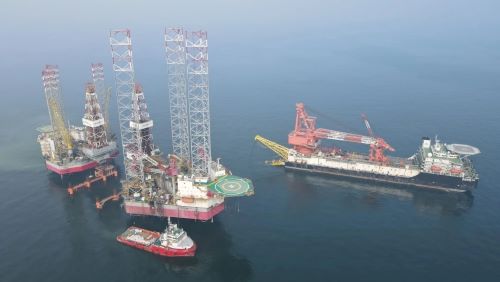
On August 22, with the successful completion of the pipeline laying task for the "Offshore Oil 202" vessel using bimetallic composite pipes (hereinafter referred to as CRA), it marked the first successful application of domestically produced CRA fully automated welding equipment on the main line of offshore pipeline laying operations, which holds significant importance for enhancing China's marine equipment manufacturing capabilities.
In this assignment, the domestic CRA fully automatic welding equipment accumulated 430 hours of operation, completed 264 weld joints, with zero equipment failures and an overall first-pass welding qualification rate of 99%.
The average laying efficiency remains stable within the range of 0.39 to 0.44 kilometers per day, meeting the expected level.
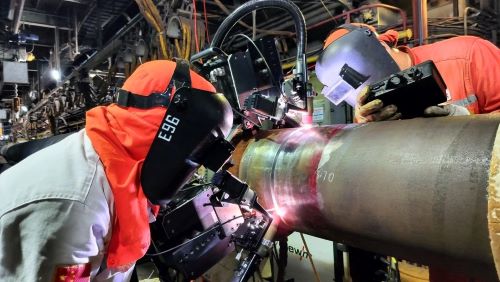
The CRA fully automated welding equipment is a critical device for offshore engineering and pipeline laying operations. Compared to manual and semi-automatic welding, the CRA fully automated welding equipment can operate continuously and accommodate pipes of all diameters.
CRA pipeline welding operation.
Previously, due to technical barriers and a lack of experimental data, domestically produced CRA automatic welding equipment was only used for auxiliary lines, conducting data verification and supporting operations. In this pipeline-laying operation, it is now being applied to the main line.
The project team also applied welding technologies such as "arc automatic tracking" and "automatic welding angle recognition" for the first time. While significantly reducing the labor intensity of welders,
The quality and efficiency of subsea pipeline laying have been significantly improved. According to preliminary estimates, domestically produced CRA fully automated welding equipment can reduce the cost of subsea pipeline laying by approximately 760,000 yuan per kilometer.
Over the years, in order to break through foreign monopolies,
To further enhance the efficiency of subsea pipeline laying, CNOOC Engineering established a specialized working group for domesticated automatic welding equipment. In collaboration with manufacturers of fully automated domestic welding equipment, they conducted over 100 tests in the workshop to ensure that welding efficiency, equipment failure rates, and the pass rate of welding results meet the expected outcomes.
In the next step, CNOOC Engineering will continue to strengthen research on key technologies and develop intelligent subsea pipeline laying equipment in terms of R&D, application, and maintenance.
Integrated technological capabilities ensure that the manufacturing of equipment is firmly under our own control.