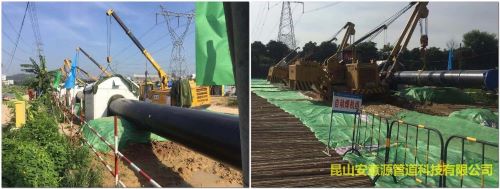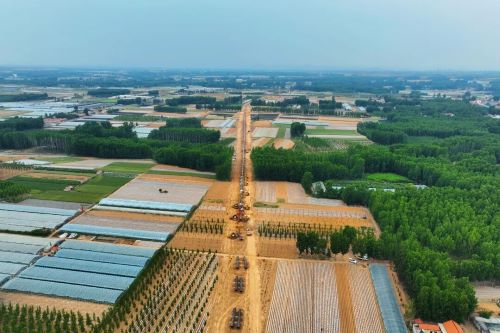
The Shenzhen LNG Emergency Peak-Shaving Station Export Pipeline Project is a supporting facility of the Shenzhen LNG Receiving Station. It serves not only as a pivotal link connecting the Shenzhen LNG Receiving Station with the Second West-to-East Gas Pipeline, but also as a critical project that links the Shenzhen LNG Receiving Station, Dapeng LNG Receiving Station and CNOOC Shenzhen Diefu LNG Receiving Station, enabling interconnection between the three receiving stations and trunk pipelines including the Second West-to-East Gas Pipeline. The early completion of this pipeline lays the foundation for fully tapping the surplus gasification and transportation capacity of LNG receiving stations in the Shenzhen area and guaranteeing the daily "South Gas to North Transport" volume of 60 million cubic meters, especially in 2019. It also constitutes an important component of the national natural gas production, supply, marketing and storage system development. Originating from the Shenzhen LNG Emergency Peak-Shaving Station, the pipeline stretches approximately 64.3 kilometers in total length with a design pressure of 10 MPa, a designed transmission capacity of 46 million cubic meters per day and a pipe diameter of 1016 millimeters. It runs through Shenzhen, Huizhou and Dongguan cities in Guangdong Province and terminates at the Guangzhou-Shenzhen Branch Line of the Second West-to-East Gas Pipeline.
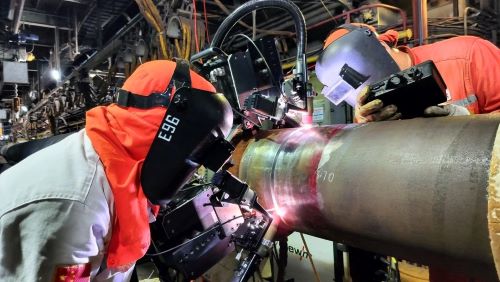
This project is undertaken by a large construction subsidiary of PetroChina. Adopting Anyiyuan's patented ART waveform-controlled root welding technology and a unique friction-drive automatic welding system, and with joint efforts from the construction firm's management and specialists alongside innovative construction methods, fully automatic external root welding has been successfully applied on this project.
Easy for welders to operate, convenient to move and equipped with simple supporting accessories, this technology delivers a high welding qualification rate, marking another breakthrough in automatic welding for long-distance transmission pipelines.
The successful application of this technology makes it viable to complete full-automatic welding covering root welding, filling and capping of weld joints with merely one set of equipment in future construction operations.