Based on the previously discussed working principles of welding machines, there are various ways to classify them. The mainstream classification methods and their corresponding types are as follows:
Classification by Welding Heat Source
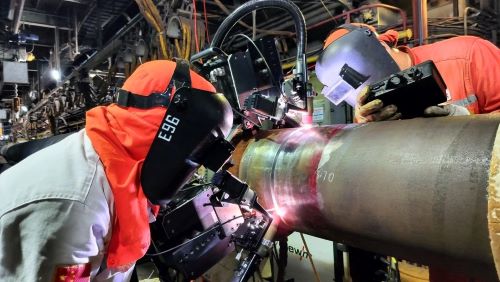
Arc Welding Machines
This is the most widely used category in the industrial sector. It includes manual arc welders, submerged arc welders, CO₂ gas-shielded welders, and tungsten inert gas (TIG/argon arc) welders. They rely on the high heat generated by an electric arc to fuse metal and are suitable for welding the vast majority of conventional metal materials.
Resistance Welding Machines
This category comprises four main types: spot welders, projection welders, seam welders, and butt welders. They utilize Joule heat-generated by electric current passing through the contact resistance of the workpiece-to perform welding. They are particularly well-suited for joining non-ferrous metals with good electrical conductivity.
High-Energy Beam Welding Machines
These are divided into laser welding machines and electron beam welding machines. Capable of achieving energy densities up to 10⁶ W/cm², laser welders are suitable for joining precision parts, while electron beam welders are primarily used for deep-penetration welding operations in vacuum environments.
Other Specialized Welding Machines
This category covers ultrasonic welders, friction welders, plasma welders, and others. They achieve welding through specialized principles such as high-frequency vibration, mechanical friction, or compressed arcs, meeting the welding requirements for special materials like plastics and dissimilar metals.